

The critical mineral has reached new norms in volatility as a result of tariffs, speculation and growth in electrification and energy transmission.
New norms for copper volatility have emerged since February of last year as tariffs, speculative trading and copper’s role in electrification and energy transmission affect pricing for the critical mineral.
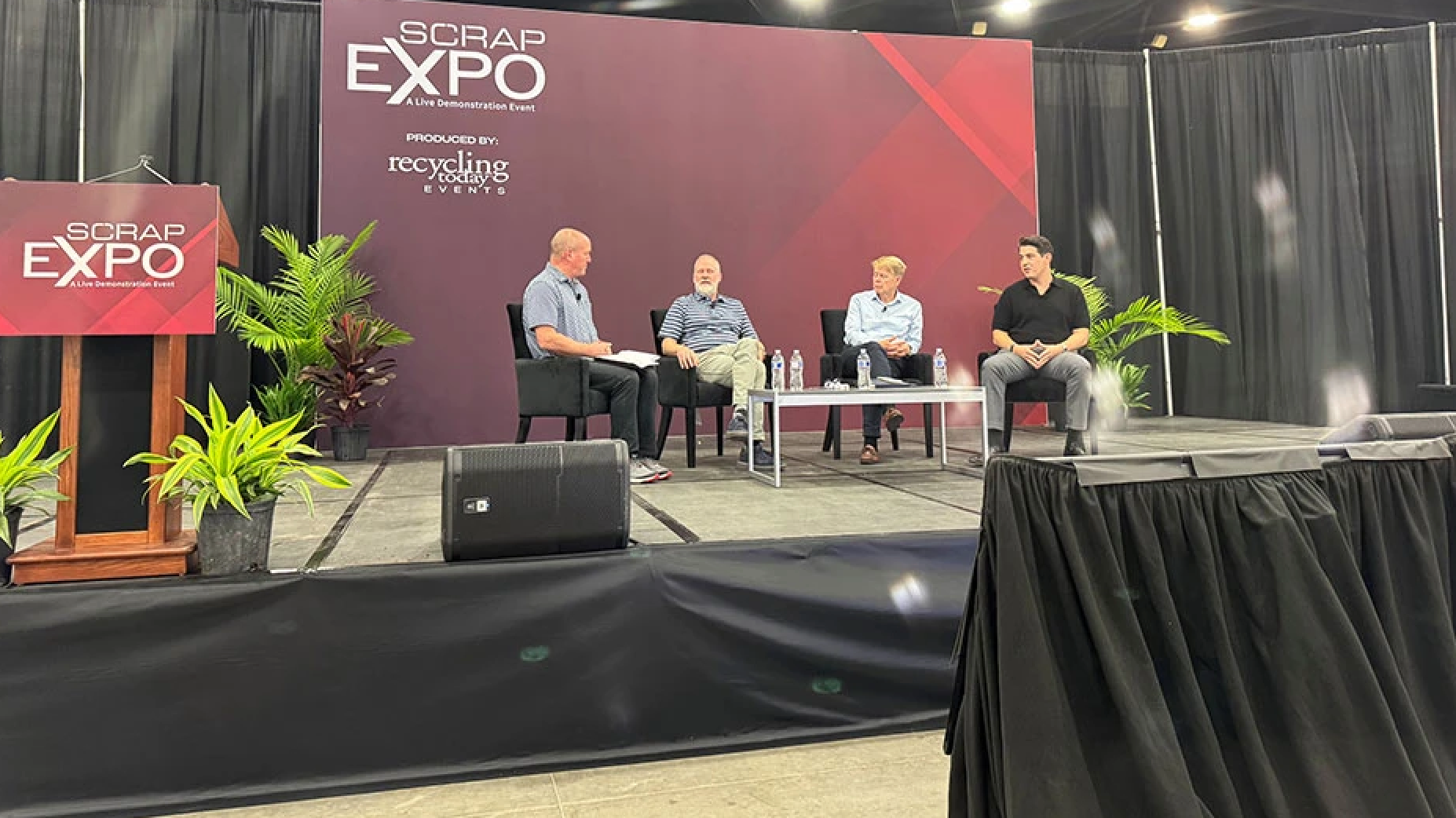
While copper prices are known for their volatility, daily swings of 14–20 cents now are considered normal, according to speakers during the Scrap Expo session Copper: A Global Commodity.
“This chop that we're seeing really since the beginning of this tariff talk has become somewhat standard,” said Mark Hadacek, director of nonferrous marketing at Alter Metal Recycling,
headquartered in St. Louis. “A 20-cent swing in a day, like we've seen recently, is par for the course.”
The heightened volatility began to emerge when President Trump launched an investigation into copper imports early in his second term. While tariffs were levied starting in August of last year on semifinished copper and copper-intensive derivative products and not on copper cathode, the volatility continues as the market expects further action from the administration related to the investigation.
To address that volatility, Hadacek says Alter is employing hedging strategies and avoiding playing the market. “We're very risk averse. We don't speculate. We're buyers every day based on what the market is and what market intel we have, and as we buy material, we hedge it and we move on to the next thing.”
He added that regardless of whether copper is $4 or $7 per pound, the company sees a consistent margin.
“When I was a young man, we typically thought the copper price had some connection to the production cost,” said Hannu Heiskanen, vice president of Multimetal Recycling Commercial at Aurubis, which is headquartered in Germany. “Premiums were based on the shipping cost to the closest port. But all that is gone.”
He added that the daily average copper hedge on the London Metal Exchange (LME) is 4 million tons, with total annual cathode sales at 21 million tons. “So in one week, LME is hedging the full annual.
Chris Lewon of Salt Lake City-based Utah Metal Works, moderator of the session, said, “There's a lot of speculation in this market for sure,” amplifying volatility and weakening the traditional link between copper prices, production costs and physical supply–demand.
Alter continues to look at various global markets and consumers of copper, Hadacek said, opting to sell its material into the best market. “We want to be competitive in the market at all times, whether that means it's going to go to India or Southeast Asia or to the domestic consumers. We're trying to sell a little bit to everybody, but it does get skewed as the markets are extremely volatile and have changed quite a bit over the last few years.”
Lewon noted that scrap accounts for 35–40 percent of the total copper market, asking the panelists how that has changed in the U.S. market with the influx of cathode.
Bret Penninger, commercial partner at Chicago-based Imperial Group LLC, said traditional consumers of copper scrap sourcing cathode at a price comparable to scrap is a worrying thought for large producers of very clean copper scrap products like his company. “What I've seen recently is that the mills really are desiring the cleanest copper grades to draw down wire into the fine, fine gauges that you need for all this data center cable. … That's what's driving the copper market right now,” he said of data centers.
“For the longest time, we haven't had really any capacity to handle the last few percentage points of copper that makes it a cathode substitute versus clove,” or No. 1 copper wire nodules. “I'll be interested to see what happens in the next few years, with some of the capacity coming online to handle that last 2 percent and bring it back up to a cathode spec, but right now there is high demand for that high, high purity, so your barley, your bare bright, is something that is very desirable, and the appetite seemingly is endless with certain types of applications,” Penninger said.
Heiskanen added that the volume of cathode in Comex warehouses in the U.S. could widen the spread between the scrap price and the terminal market price for copper. “The scrap deductions may get a bit worse for the audience, better for us.”
Regarding a potential copper scrap export ban in the U.S., Penninger said, “In my opinion, that wouldn't be a very wise thing to do. Getting the capacity back on American shores, I'm all for that. But it's not a quick process, bringing these types of facilities online. … And with the winds changing on a tweet, it's very hard to invest the type of capital that is needed in order to bring these types of facilities to fruition.”
While he welcomes Aurubis Richmond and Wieland’s investment in Shelbyville, Kentucky, Penninger adds that they consume certain types of copper scrap, “so we will always need overseas capacity for a lot of the various grades that we have. You can only upgrade a product so much or get it to the proper value that it needs to be for you to make money on it for it to go direct to a consumer. I think that there's still a lot of hands that touch a lot of different grades of scrap overseas. That's necessary. It's a pressure release valve, and for the commodities that we really want to keep here, sure, the price will be the thing that dictates keeping it here, not putting some type of broad ban on it just because.”
India is a growing consumer of copper scrap, with Hadacek saying consumers there are growing in sophistication as well.
“India is a big threat for a company like us,” Heiskanen added. “Their government actually took out all the import taxes on the scrap and the primary feed, but they put a cathode tax of 5 percent, so now the copper price in India is 5 percent higher, and they can always compete.”
While he said the scenario makes Indian end products too expensive to be sold in U.S., “they can always outbid anyone else” for feedstock. “You [scrap suppliers] would love it. We hate that.”
Penninger also advised recyclers to be on the lookout for copper-clad aluminum wire. “It looks just like copper from the outside. And when you cut it on the end, sometimes you have that copper cladding kind of pinch at the tip, so even on a cross section, you can't see it,” he said. “If you're making ICW [insulated copper wire] bundles, and you think that you've got something that is a $6-a-pound product, and … 70 percent of that material is actually aluminum.”
Penninger added that it’s difficult for wire chopping lines to get the material out of the downstream, “and we're seeing it more and more.”
While copper-clad aluminum wire is one example of copper being substituted with another material, the panelists agreed that electrification, data centers and grid/renewables buildout are driving copper demand and will more than offset substitution in specific applications.
Scrap Expo, organized by Recycling Today, was Sept. 9-10 in Louisville, Kentucky, at the Kentucky Expo Center. Scrap Expo 2027 will be at the same venue Oct. 12-13.
The news from Recycling today. more info, yon can visit Recycling today. https://www.recyclingtoday.com/